Dates: 24–25 Nov 2026 · 6.30pm to 11.30pm
The November full moon, the Beaver Moon, rises over Singapore at 6.34pm on Tuesday 24 November 2026 and is full at 10.53pm. It is a supermoon, a full moon near its closest point to Earth. The next night, Uranus reaches opposition, its closest and brightest for the year. The Moon needs only a clear sky; the planet needs binoculars.


At a glance
Neighbourhood
Anywhere with a clear, low view to the east-north-east: Marina Barrage, East Coast Park or Changi Beach Park work well
Best for
Stargazers, photographers, couples and families who want a free evening outdoors
Budget
Free; binoculars help for Uranus
Time to allow
30 minutes for the moonrise; an hour or more if you want to hunt for Uranus
Nearest MRT
Gardens by the Bay (TE22) for Marina Barrage; Marine Parade (TE26) for East Coast Park
Good to know
Moonrise is 6.34pm on 24 Nov and 7.39pm on 25 Nov. The Science Centre Observatory isn’t holding special sessions; its regular Friday night runs on 27 Nov
Why go?
Moonrise on Tuesday comes in the last of the daylight, so you see a big, low, often orange Moon climbing over the sea and the skyline in the evening, not at 3am.
It is the first of three supermoons in a row, with the next two in December 2026 and January 2027, so it is a good night to practise moon photography.
Uranus is at opposition in the constellation Taurus, close to the easy-to-spot Pleiades cluster. That makes this the best week of 2026 to find Singapore’s hardest naked-eye planet.
What to do
01 · Catch the moonrise on Tuesday 24 November
Timeanddate.com puts moonrise in Singapore at 6.34pm on 24 November, at a compass bearing of about 65°, which is east-north-east. The Moon is exactly full at 10.53pm. Be in place by about 6.20pm and look just north of due east. A low horizon matters more than darkness, because buildings and trees will hide the first half hour. If you miss Tuesday, the Moon looks just as full on Wednesday 25 November, when it rises at 7.39pm (99.8% lit), or on Monday 23 November, when it rose at 5.34pm. A supermoon looks only slightly bigger than an ordinary full moon to the eye, so the drama comes from catching it low against a landmark.
02 · Find Uranus on the night of 25 November
EarthSky gives the moment of opposition as 23:00 UTC on 25 November, which is 7am on 26 November in Singapore. So the best night is Wednesday 25 November into the early hours of Thursday. Uranus rises in the east around sunset and is highest around midnight. It shines at magnitude +5.6, at the very limit of the naked eye even under dark skies, and it is 18.4 astronomical units away, about 2.6 light-hours. Find the Pleiades first (a small, tight cluster of stars in Taurus), then scan nearby with binoculars for a faint, slightly greenish ‘star’ that doesn’t twinkle. Through a telescope it shows as a tiny blue-green disc 3.8 arcseconds across.
03 · Why Friday 27 November may be better for the planet
This week the nearly full Moon is the problem: its glare washes out faint objects like Uranus. On Friday 27 November the Moon doesn’t rise until 9.51pm. That gives you a dark-ish window from nightfall until about 9.45pm, with Uranus already well up in the east. That Friday is also a regular public night at the Science Centre Observatory, which runs a planetarium show from 7.30pm and stargazing on its telescopes from 8.15pm to 10pm, every Friday unless stated. Uranus stays bright enough for binoculars until mid-December, so you don’t have to see it on the exact night.
Plan your visit
Address
Suggested viewing spot: Marina Barrage, 8 Marina Gardens Drive, Singapore 018951 (Green Roof open 24 hours). Alternatives: East Coast Park seafront; Changi Beach Park
Opening hours
Moonrise 6.34pm on Tue 24 Nov (full at 10.53pm) and 7.39pm on Wed 25 Nov; Uranus is best from about 8pm until after midnight on 25 Nov
Getting there
Marina Barrage: Gardens by the Bay MRT (TE22), then walk along Marina Gardens Drive, or bus 400. East Coast Park: Marine Parade MRT (TE26), then the underpass to the park
Tickets or booking
Free. Science Centre Observatory Friday sessions (7.30pm to 10pm) need a ticket from the Science Centre
Accessibility
Marina Barrage’s roof and East Coast Park’s seafront paths are step-free; bring insect repellent for the parks
Before you go
- Check the cloud before you go. Late November is the start of the northeast monsoon, and a band of cloud on the eastern horizon is the usual spoiler; the Moon can still appear higher up later in the evening.
- For photos, use the longest lens you have and frame the Moon against something far away, such as the skyline from Marina Barrage or ships off East Coast Park. Shoot in the first 20 minutes after moonrise, while the sky still has some light.
- For Uranus, give your eyes 20 to 30 minutes to adapt and dim your phone screen. A free star-map app helps you find Taurus and the Pleiades.
- Missed it? The next Uranus opposition is on 30 November 2027, and December’s full moon is also a supermoon. Want telescopes and a guide? See our Science Centre Observatory Friday stargazing guide and Singapore for stargazers. For the roof itself, see our Marina Barrage guide.
The Moon over Singapore


Sources and disclosure
Information checked: 23 November 2026 · timeanddate.com: Moonrise, moonset and moon phases in Singapore, November 2026 · EarthSky: Uranus at opposition on November 25, 2026 · Science Centre Singapore: Astronomy and stargazing programmes (official) · Secret Singapore: Where to catch the Beaver Moon and Uranus in Singapore
Photos: Wikimedia Commons and NASA contributors, used under the licences shown in each caption (images resized): Zexsen Xie (CC BY 2.0); NASA/Bill Ingalls (Public domain); RFNirmala (CC BY 4.0); Adhirk at English Wikipedia (Adhir Kirtikar) (CC BY-SA 3.0)
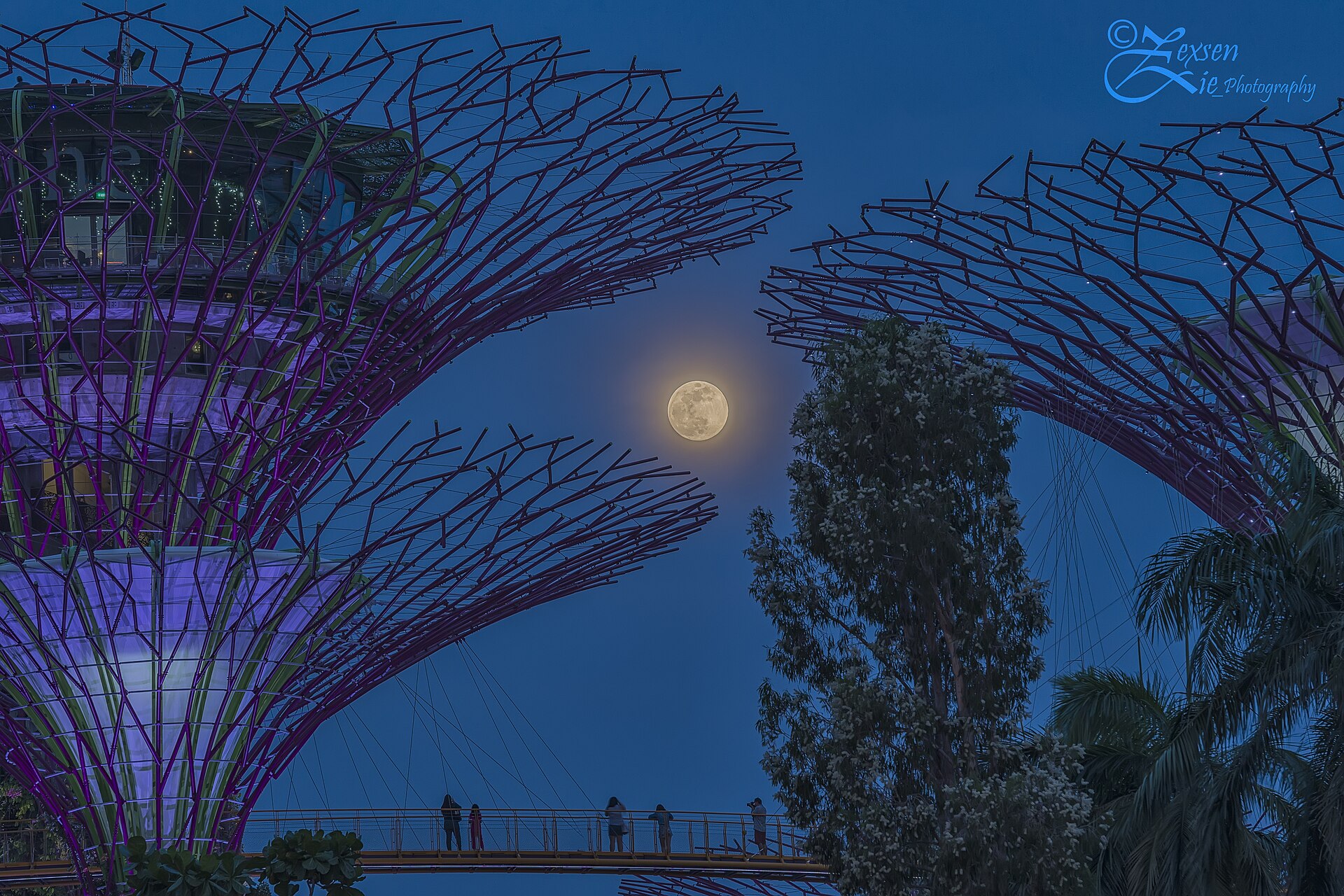
Disclosure: Not a firsthand viewing. Moonrise, moonset, phase and bearing times come from timeanddate.com’s Singapore tables, and the Uranus opposition time, brightness, distance and position come from EarthSky, both checked on 23 November 2026. Science Centre Observatory times are from its official page. The viewing spots, the Friday window and the tips are our own. The first photo shows a full moon over Gardens by the Bay in 2014, not this supermoon; the second is a NASA photo of a 2017 supermoon in Washington. We weren’t paid or hosted, and there are no affiliate links.